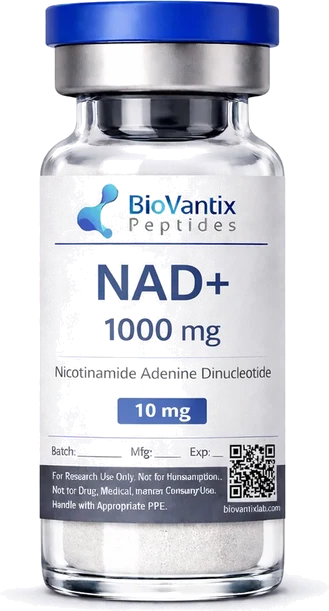
Foto de referencia: la etiqueta puede mostrar otra presentación.
Nicotinamide adenine dinucleotide (NAD⁺) is a pyridine nucleotide cofactor that exists in both its oxidized (NAD⁺) and reduced (NADH) forms. In biochemical and cellular research, NAD⁺ is primarily studied as an electron carrier involved in redox reactions and as a substrate for multiple classes of enzymes. Published literature describes NAD⁺ as a molecule involved in intracellular metabolic networks and, in specific experimental settings, extracellular signaling measurements.

Videos de creadores independientes en YouTube. BioVantix no los produce ni los respalda, y no son instrucciones de uso. Se cargan desde YouTube solo al reproducirlos.
Para quien quiera profundizar: cómo actúa, qué encontraron los estudios y las fuentes.
All information presented below is provided strictly within the context of preclinical research. No therapeutic, diagnostic, or medical claims are made or implied.
Molecular Formula: C₂₁H₂₇N₇O₁₄P₂
Molecular Weight: 663.43 g/mol
PubChem CID: 925
CAS Number: 53-84-9
NAD⁺ functions as an active redox cofactor capable of accepting and donating electrons during enzymatic reactions. In experimental systems, NAD⁺ availability is commonly evaluated as a measurable variable associated with metabolic flux, enzymatic activity assays, and intracellular signaling. NAD⁺ is also investigated as a substrate for enzymes involved in post-translational modification processes, including ADP-ribosylation.
In laboratory research, NAD⁺ is used as a reference compound or experimental variable in:
All applications are limited to controlled in vitro research settings or animal models.
Throughout the referenced literature, NAD⁺ is discussed in relation to multiple metabolic pathway–annotated datasets. These discussions are presented as reported measurements, observed associations, or differential expression trends rather than direct functional outcomes. Frequently referenced pathway contexts include:
Mitochondrial and Metabolic Models
Animal and cell-based studies describe associations between NAD⁺ availability and measured mitochondrial parameters, including markers of oxidative phosphorylation and indicators of redox status. These findings are presented as dataset-level observations derived from preclinical models.
Gene Expression and Aging-Associated Datasets
Transcriptomic analyses in aging-related models report differential expression patterns across nuclear and mitochondrial gene sets under experimental conditions involving altered NAD⁺ levels. Interpretation is limited to the reported expression profiles rather than direct claims of functional restoration.
Neurodegeneration-Focused Models
In murine models of neurodegenerative disease, published studies report associations between NAD⁺ exposure and markers of neuronal survival, oxidative stress indicators, and measured mitochondrial parameters. These observations are presented as preclinical correlations within disease model systems.
Inflammation-Related Measurements
Several studies reference NAD⁺-associated datasets involving NAMPT, cytokine measurements, and inflammatory signaling components. Reported findings are based on gene expression profiles, enzymatic activity measurements, or pathway-level annotations.
Collectively, the scientific literature positions NAD⁺ as a biochemical variable used to investigate mechanisms related to metabolism, aging, and cellular stress in non-clinical research systems.
This product is supplied as a research-grade compound intended exclusively for laboratory use. Analytical characterization may include chromatographic purity assessment and identity confirmation by mass spectrometry. Batch-specific specifications should be verified using the accompanying Certificate of Analysis (COA), where available.
ALL ARTICLES AND PRODUCT INFORMATION PROVIDED ON THIS WEBSITE ARE FOR INFORMATIONAL AND EDUCATIONAL PURPOSES ONLY.
For laboratory research use only. Not for human, medical, diagnostic, or veterinary use.
All of our products are manufactured using the lyophilization (freeze-drying) process, ensuring they remain 100% stable during shipping for up to 3–4 months.
Upon receiving your peptides, it is essential to keep them cool and protected from light. If the peptides will be used immediately, or within the next few days, weeks, or months, short-term refrigeration below 4°C (39°F) is generally sufficient. Lyophilized peptides are typically stable at room temperature for several weeks or longer, so room-temperature storage is generally acceptable if they will be used within a relatively short period.
However, for long-term storage (several months to years), peptides should ideally be kept in a freezer at -80°C (-112°F). Freezing is the preferred method for preserving peptide stability over extended periods.
For more information on proper peptide storage techniques, click the following link:
:::
SKU: NJ500-2